
How to Get Court Records
Texas runs these as two separate record systems, even though the statewide directory lists Tiffany Howard as both District Clerk and County Clerk. District matters go to the District Clerk. Constitutional county-court matters go to the County Clerk. Both offices sit at Courthouse Box 4, 100 Avenue E NW, Childress, Texas 79201, and share the phone 940-937-6143. Begin on the official District Clerk page or County Clerk page. Each access channel has its use. You can check re:SearchTX for a participating case, view an open file at the clerk counter, call to learn the request process, or mail a focused request to the courthouse. Try email or fax only after staff confirms that channel, its security rules, and its payment method. The statewide system supplements the local office. It does not cover every Childress County case.
- Identify the exact court and cause number, if known.
- Name the docket, order, judgment, or filed item needed.
- Choose state portal, counter, phone, or mail access.
- Ask for a price quote and expected response method.
- Specify a plain or clerk-certified copy before paying.
Childress Court Clerk Roles
One elected clerk serves both courts, but the files stay separate. The 100th Judicial District Court keeps its own dockets. Those dockets cover felonies, district civil cases, family law, juvenile matters, and other district business. Childress County Court handles other work. Texas law assigns it the constitutional county-court load: Class A and B misdemeanors, probate, guardianship, and mental-health cases. So a Childress County docket search works best when you name the court. The level alone is not enough. A request that says only "county court" may not settle which office truly holds the Childress County court records you need.
| Custodian | Typical Childress record | Best identifier |
|---|---|---|
| District Clerk | District civil, family, felony, juvenile file | District court and cause number |
| County Clerk | County misdemeanor, probate, guardianship file | County court and cause number |
| Justice of the Peace | JP citation or limited civil file | Citation or case/cause number |
| Municipal Clerk | City ordinance or Class C case | Municipal citation number |
Know your limits before you call the clerk. Staff at the Childress County clerk's office have no general duty to search records unless a statute authorizes it. Without a cause number, give a narrow name or style plus a date range. Staff can walk you through access to court records. But they cannot promise what an open-ended name search will turn up in the docket.
Types of Childress Court Records
The docket is the timeline; the case file is the paperwork behind it. One lists every court date and filing in order. The other holds the actual documents. When you make a request, think small: a single signed order may be all you need, not the whole file. That choice matters. Some papers are public, some are redacted, and some are sealed by statute or court order.
- Petitions, complaints, answers, motions, and responses
- Citations, summonses, service returns, and other process
- Signed orders, judgments, sentences, and dispositions
- Notices, docket entries, costs, fines, and payment entries
- Public exhibits and appellate documents held in the file
Some files carry heavier locks. Family, juvenile, probate, guardianship, mental-health, and child-protection records in Childress County can face stronger limits than an ordinary civil or criminal docket. Ask the clerk for the named public item, or for a redacted version. Do you need a transcript? The clerk may tell you it comes from the court reporter rather than through a case-file copy.
Childress LGS Is Not Court Records
The County Clerk points visitors to an LGS system for official and land records. That system is not a Childress County trial-court docket search. Think of the index like a library catalog. It points you to an instrument. But it is not the instrument, and it certifies nothing. Images can also go missing during backup work.
The LGS landing page allows guest and account access. Guest searches return index data, while full images and purchases may require registration and payment. A court cause number may return nothing there even when a real court file exists. Property litigation may call for two searches. Look for the lawsuit through the court clerk, then the official instrument through LGS. The County Clerk's own portal page makes that split clear. It points to the official office. It also warns that an online index is not a certified court record.
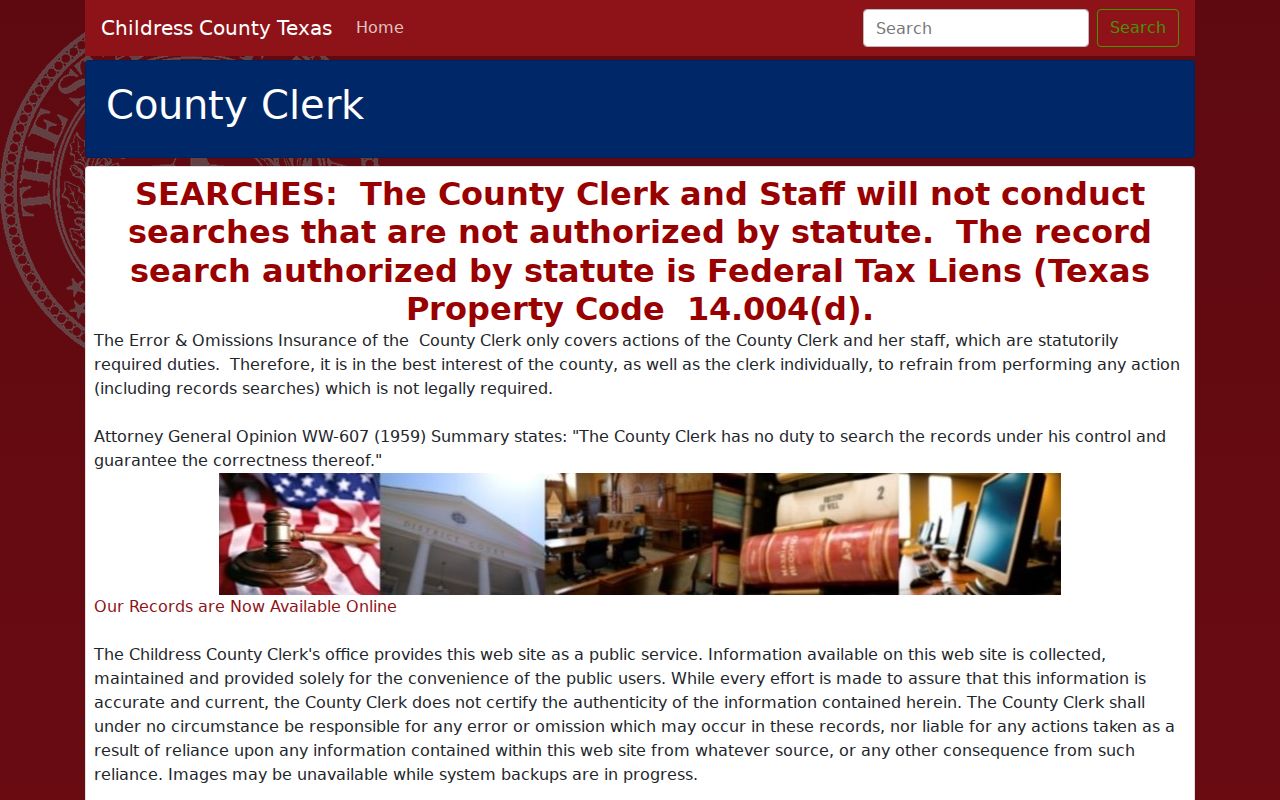
The official office named there is the authority on the record. Its disclaimer says plainly that an online index is not a certified copy, so treat what you find as a lead, not the record itself.
What a Court Record Contains
What sits inside a court record depends on the court and the case type. A quick inventory helps, though. It lets a requester name the exact item wanted. It also helps tell a docket entry apart from a signed ruling. The statewide sample and the Texas clerk manual use these field families.
| Case or cause number | The court-assigned identifier used to locate the file. |
|---|---|
| Style and parties | The case title and public party roles, subject to access limits. |
| Pleadings | Petitions, answers, motions, responses, and other filed papers. |
| Process | Issued citation or summons and service or return events. |
| Orders and judgment | Proposed or signed rulings, final judgment, sentence, or disposition. |
| Docket events | Dated filings, settings, hearings, uploads, and clerk entries. |
| Costs and payments | Separate financial fields that do not by themselves prove disposition. |
An event description is not the filed document. When legal effect matters, ask for the signed order that actually operates in the case. A certified judgment may differ, too, from an abstract or a portal image.
Narrow Childress Court Record Requests
Asking the Childress County clerk to "send everything" on a case rarely works well. The request is hard to price, and it can drag in restricted or useless material. Narrow it down instead. Name the court, the cause number, and the rough date of the event. Add the document title and the copy form you want. A model request reads: "Please advise the cost and process for a noncertified copy of the signed final judgment filed on the identified filing date in the named court, using the full cause number." With wording like that, a clerk can pull one court record. There is no broad digging through the docket.
Best request: Name the court, cause number, filed item, date range, certification choice, and preferred delivery channel.
Sometimes a Childress County docket search turns up nothing online. Before giving up, consider the reasons. The court record may predate electronic coverage, sit in another court, or fall under a different case category. It may also need review at a terminal or carry an access limit. Describe the result carefully, too. "Not found in the public search checked" is accurate. It is never proof that the record does not exist.
Certified Copies and Fees
Know the difference before you pay. A plain copy just reproduces the public item from the court file. A certified copy adds the clerk's authentication, sometimes with a certificate or seal. Ask the recipient which form is required first. Childress County publishes no full fee schedule in accessible text. Confirm local copy and certification charges directly with the office.
| Item | Amount or rule |
|---|---|
| Local plain copy | Confirm current per-page or electronic rate with the clerk |
| Local certified copy | Confirm copy charge plus current certification fee |
| re:SearchTX public document | $0.10 per page, $1 minimum per document; OCA materials describe a $6 cap |
| LGS purchase | $0.30 mandatory transaction fee; image and subscription terms vary |
Fees for copies from the district clerk trace back to Texas Government Code chapter 51. County-level charges sit in Local Government Code chapter 118. Rates and portal terms shift over time, so ask the clerk for a cost estimate before ordering a thick file.
District and County Clerk
Courthouse Box 4, 100 Avenue E NW
Childress, TX 79201
940-937-6143
Childress State Court Record Limits
One statewide option is re:SearchTX access. It pulls case, filing, event, and document details from Texas courts that take part. A public user may need an account, and some images cost money. Attorneys of record can get broader access. Even so, official Texas guidance is blunt: no single statewide search covers every trial-court case. The state sample entry lists location, case category, case type, filed date, and parties. It also lists events, comments, page count, price, and document status. Childress County coverage varies. So treat a hit as a lead and confirm with the clerk. A blank result may just mean the court was not included. The statewide access screen shows where the state layer begins.
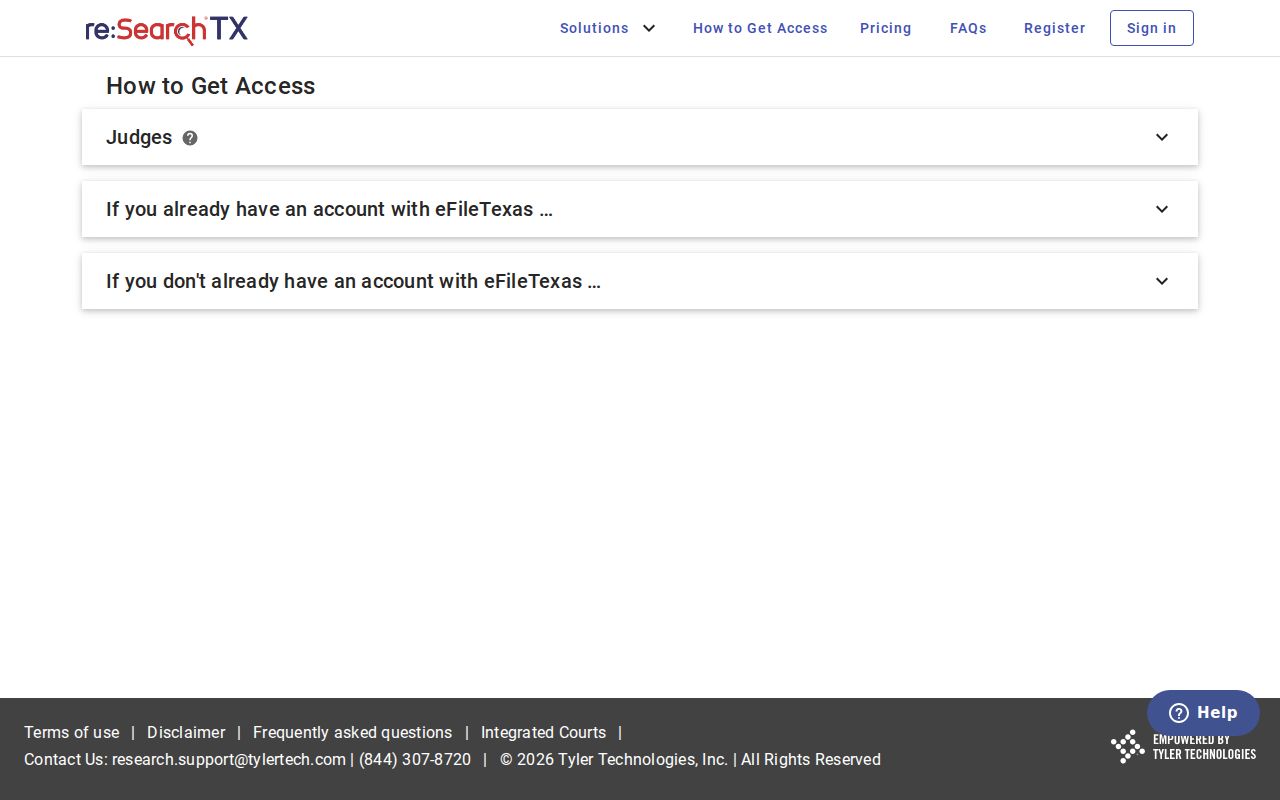
The screen handles account and access choices. For a complete or certified Childress County record, though, the local clerk is still the source.
Public Access and Sealed Records
Getting Texas court records is not like a routine agency request. The Office of Court Administration puts it plainly. Courts and judicial agencies do not fall under the Texas Public Information Act or federal FOIA in the usual way for judicial records. Ask the clerk or the court that holds the file. Use the rules for that case. Rule 12 covers mainly administrative, non-adjudicative judicial records.
Key rules:
OCA open-records policy explains the judicial-record request route and the PIA distinction.
Texas Rule of Judicial Administration 12 governs many administrative judicial records.
Texas Rule of Civil Procedure 76a supplies a process for sealing certain civil court records.
Texas Family Code chapter 58 governs key juvenile-record limits.
A portal screen that comes back empty can hide several things. It may be a sealed case, a sealed paper, or a redacted copy. It may be statutory confidentiality or a plain coverage gap. The Childress County District Clerk links a 100th District standing order on public access to DFPS records. It still pays to ask what remains open. That could be a public docket-only view, a redacted copy, a judgment, or a non-sensitive index entry. The official judicial-record policy page lays out the state distinction.
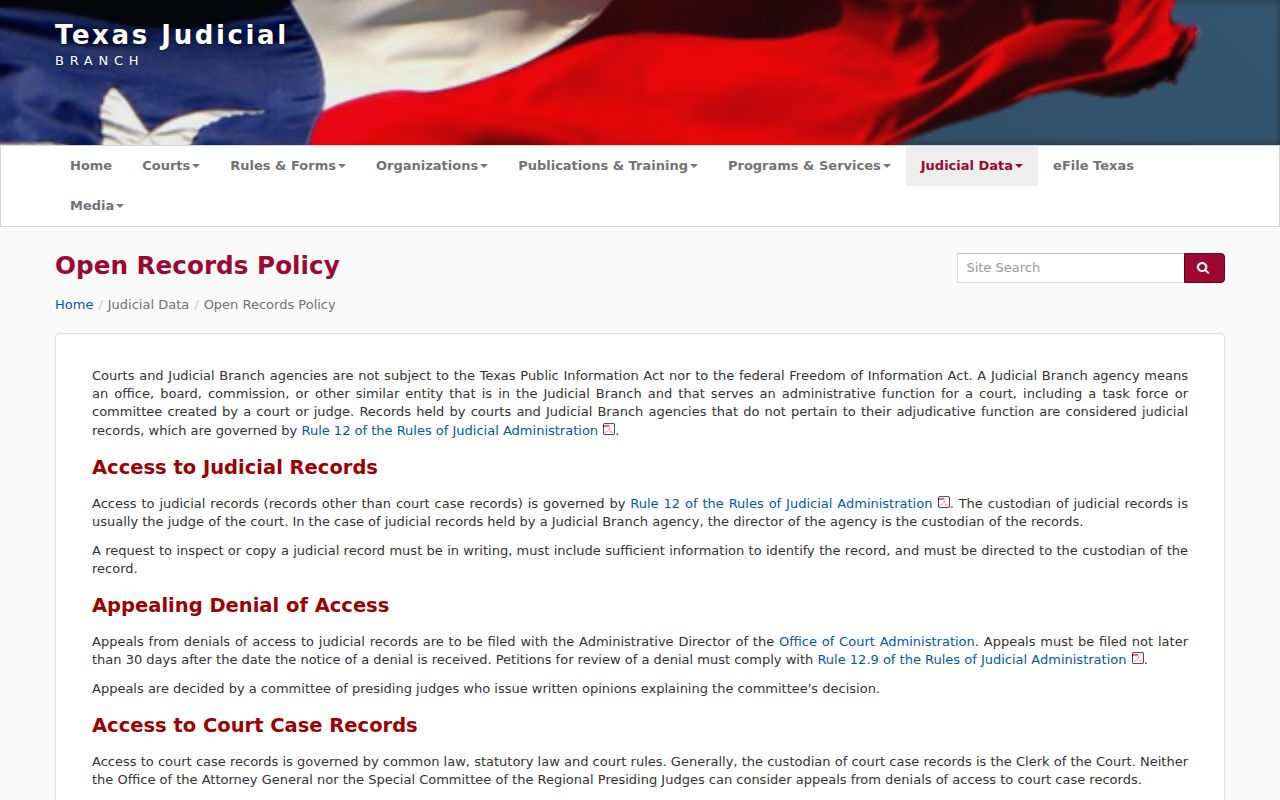
Its request route points to the same lesson: send a court case file request to the proper Childress County custodian, not to an unrelated agency portal. Note: The Sheriff's written open-records route covers law-enforcement records only. It cannot substitute for a request aimed at a filed court document.
Verify Childress Court Records
Check before you rely on any Childress County court record. Look at the court name, cause number, filing date, signature status, and certification. A portal image can be current but uncertified. An index may leave a document out. A docket event may prove only that something was filed, not what the judge ordered. The safest chain is short. Name the court and find the cause number. Request the exact record, then verify it with the custodian. Need the search step ahead of a copy request? The Childress County case search page walks through county and state lookup routes. The clerk can then confirm access, price, and format. The clerk can also tell you whether the file is complete for your date range.